
Why Printed Menus Are a Hidden Cost Center
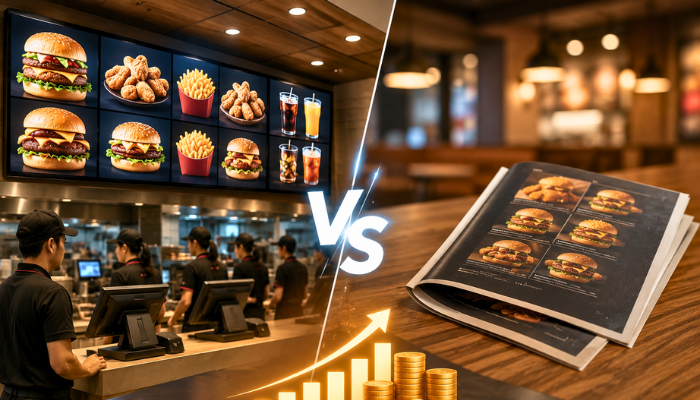
Every price change, seasonal deal, or new item on a printed menu board means a reprint — design cost, printing cost, and installation labor, multiplied across every branch for chains with multiple locations. During Ramadan, Eid, or a sudden ingredient price change, printed menus lag behind reality, either showing outdated prices or forcing rushed reprints. A Digital Menu Board removes this cycle entirely: one update from a central system pushes to every screen, at every branch, simultaneously.
This is the core ROI argument — not that digital “looks better,” but that it removes a recurring operational cost that scales with the number of branches and the frequency of menu changes.
Where Digital Menu Boards Pay Off Fastest
1. Multi-Branch Chains
A chain with 5+ branches sees the clearest ROI, since one centralized price or promo update replaces reprinting and redistributing physical menu boards across every location.
2. Frequent Promotion Cycles
Fast food chains running weekly or monthly deals (combo meals, limited-time items, Ramadan iftar deals) benefit most, since digital boards support this update frequency at zero marginal cost per change.
3. Drive-Thru Lanes
A separate digital screen at the drive-thru order point can highlight combo upsells specific to that ordering moment, something a single static printed board can’t do dynamically.
4. High-Traffic Counter Areas
Digital boards can rotate between core menu, limited-time offers, and combo suggestions during peak hours, giving upsell visibility without cluttering a single static layout.
Printed vs Digital: Direct Comparison
| Factor | Printed Menu Board | Digital LED/LCD Menu Board |
|---|---|---|
| Price update cost | Reprint + reinstall per change | Instant, centralized update |
| Multi-branch consistency | Manual, branch-by-branch | Synced automatically across locations |
| Promotional flexibility | Fixed until reprinted | Rotates offers, combos, time-based deals |
| Initial cost | Lower upfront | Higher upfront investment |
| Long-term cost (frequent changes) | Higher over time | Lower over time |
| Visual impact | Static | Motion, highlight, and upsell visuals possible |
Recommended Setup by Restaurant Size
| Restaurant Type | Recommended Screens | Pixel Pitch / Type |
|---|---|---|
| Single small outlet | 1 overhead menu screen | Indoor LCD or fine-pitch LED, P2.5–P3 |
| Mid-size branch | Overhead menu + counter promo screen | P2.5 overhead, smaller promo screen at counter |
| Multi-branch chain | Centralized CMS-managed screens per branch | Standardized across all locations for brand consistency |
| Drive-thru enabled | Overhead + dedicated drive-thru order screen | Weatherproof if outdoor-facing |
Calculating the ROI Case
The real comparison isn’t screen cost vs. printed board cost as a one-time purchase — it’s total cost over a year of typical menu activity. A chain that changes pricing or promotions monthly, across multiple branches, accumulates reprint and redistribution costs that a digital system avoids entirely after the initial investment. The payback period shortens further for chains running frequent limited-time offers, since each promotional cycle that would have required new printed boards instead costs nothing beyond a content update.
Content Strategy for Menu Board ROI
- Highlight combo deals visually (bundled pricing, “recommended” tags) rather than listing every item at equal visual weight
- Rotate limited-time offers during specific dayparts (breakfast, lunch, dinner) instead of running one static layout all day
- Keep pricing large and legible from the counter queue distance, not just from directly in front of the screen
- Sync price changes across all branch screens simultaneously to avoid customer confusion between locations
Common Mistakes to Avoid
- Treating the digital board as a static image display instead of using its update and rotation capability
- Overcrowding one screen with the entire menu at equal visual priority, losing the upsell advantage
- Inconsistent pricing across branches due to manual, non-centralized updates
- Choosing a pixel pitch too coarse for menu text, resulting in blurry pricing from a normal counter queue distance
FAQs
Q: Is a digital menu board worth it for a single small restaurant?
A: It can be, particularly if the menu or pricing changes often. For a restaurant that rarely changes its menu, the ROI case is weaker than for a multi-branch chain with frequent promotions.
Q: How is content updated across multiple branches?
A: Through a centralized content management system that pushes updates to all connected screens simultaneously, avoiding manual per-branch changes.
Q: What pixel pitch is recommended for menu boards?
A: P2.5–P3 is common for overhead menu boards viewed from a normal counter queue distance, ensuring text and pricing stay legible.
Q: Can digital menu boards be used for drive-thru lanes?
A: Yes, with a weatherproof outdoor-rated screen positioned at the order point, often showing combo-specific upsells relevant to that ordering stage.
Q: Does a digital board fully replace the need for printed materials?
A: In most cases yes, for the primary menu display, though some chains still keep small printed materials for takeaway or delivery packaging separately.