Introduction
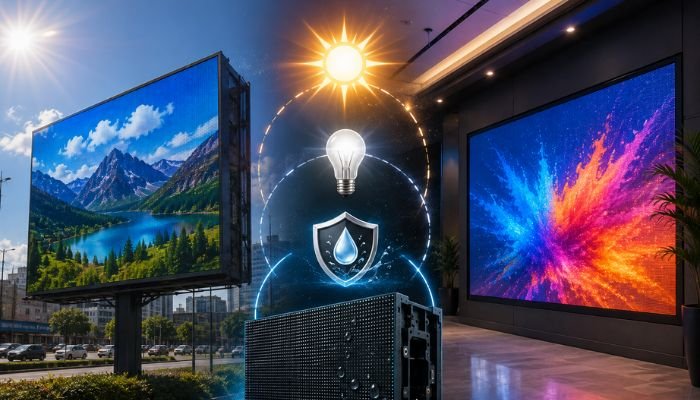
When Pakistani businesses choose an SMD screen, they often focus on pixel pitch, brand name, and resolution. However, brightness — measured in nits — is one of the most important specifications for ensuring that an LED display remains clear, vibrant, and visible in its intended environment. A screen with the right brightness level can deliver sharp and engaging visuals, while an unsuitable brightness level can affect readability and overall viewing quality.
This guide explains LED screen brightness in practical terms: what nits mean, how much brightness you need for different environments, and how IP ratings help protect outdoor installations. We’ll also cover related specifications — including lumens vs. nits, viewing angles, and contrast ratios — that work together with brightness to determine an SMD screen’s real-world performance.
What Are Nits? Understanding LED Screen Brightness
A “nit” (from the Latin “nitere,” meaning “to shine”) is a unit of luminance equal to one candela per square meter (cd/m²). It measures how much light a surface emits per unit area. For SMD screens:
- 1 nit = 1 cd/m² (candela per square meter)
- Higher nits = brighter screen = more visible in bright environments
- Brightness directly affects both cost and power consumption
Nits vs. Lumens: What’s the Difference?
People often confuse nits and lumens. The difference matters for LED screen buyers:
- Nits (cd/m²): Measures brightness emitted from a surface (the screen). Used for LED displays and screens.
- Lumens (lm): Measures total light output from a source (a projector, a bulb). Used for projectors and lighting fixtures.
- Lux (lx): Measures light falling on a surface (ambient light). Used to measure environmental brightness.
For SMD screens, nits is the correct unit. A 7,500-nit outdoor LED screen emits 7,500 candelas per square meter — bright enough to overcome sunlight that measures 100,000 lux at ground level in Pakistan during peak daytime.
How Much Brightness Do You Actually Need?
Screen brightness must exceed ambient light by a comfortable margin to remain readable. Here’s the brightness requirement for common environments in Pakistan:
Indoor Environments
| Environment | Ambient Light (lux) | Required Brightness (nits) | Example |
|---|---|---|---|
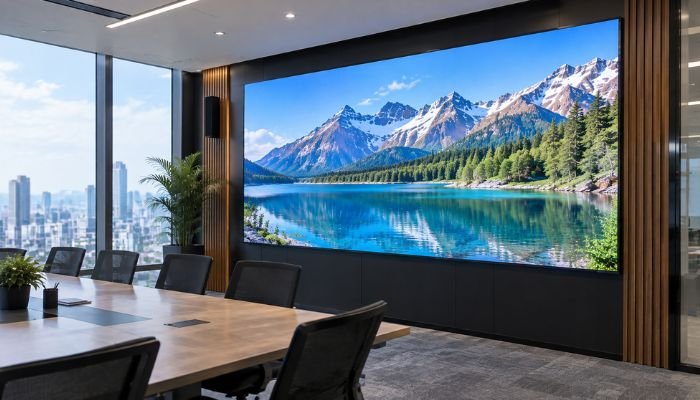
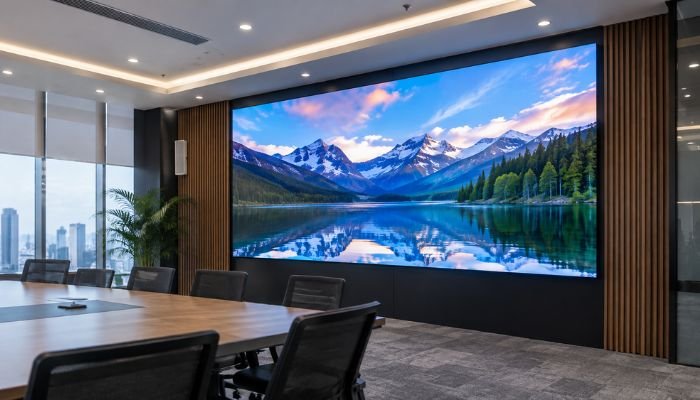
| Windowless room, dim lighting | 100-300 | 800-1,200 | Home theater, dark conference room |
| Standard office/retail lighting | 300-500 | 1,200-1,800 | Corporate office, retail store |
| Bright office/mall interior | 500-1,000 | 1,800-2,500 | Shopping mall atrium, hotel lobby |
| Indoor near large windows | 1,000-3,000 | 2,500-3,500 | Glass-walled office, showroom with windows |
Semi-Outdoor Environments
| Environment | Ambient Light (lux) | Required Brightness (nits) | Example |
|---|---|---|---|
| Shaded outdoor area | 3,000-10,000 | 3,500-5,000 | Covered patio, parking structure |
| Outdoor under canopy | 5,000-15,000 | 5,000-5,500 | Petrol pump canopy, building entrance |
| Open but north-facing | 10,000-30,000 | 5,500-6,500 | North-facing wall, shaded courtyard |
Outdoor Environments
| Environment | Ambient Light (lux) | Required Brightness (nits) | Example |
|---|---|---|---|
| Overcast outdoor | 10,000-25,000 | 5,500-6,500 | Cloudy day billboard display |
| Partial sun exposure | 25,000-50,000 | 6,500-7,500 | Building facade, afternoon sun |
| Direct sunlight (Pakistan standard) | 50,000-100,000 | 7,500-10,000+ | Roadside billboard, roof-mounted screen |
| High-altitude or snow reflection | 100,000-120,000 | 10,000+ nits | Northern Pakistan highlands |
Pakistan-specific note: Pakistan’s latitude means the sun is particularly intense from April to September. An outdoor screen that looks fine in winter (December-February) may become unreadable in summer. Always specify brightness based on your brightest season, not the average.
The Contrast Ratio: Brightness’s Crucial Partner
Brightness alone doesn’t guarantee visibility — contrast ratio matters equally. Contrast ratio is the difference between the brightest white and the darkest black the screen can produce. A 7,500-nit screen with poor contrast looks washed out in sunlight, even though it’s “bright enough.”
What Affects LED Screen Contrast?
- Black LED surface treatment: Quality outdoor screens use black-face LEDs with dark encapsulation, producing deeper blacks. White-face LEDs appear brighter but have lower contrast.
- Surface reflection: Glossy LED surfaces reflect ambient light, washing out the image. Matte or anti-glare treatments reduce reflection and improve perceived contrast.
- Dynamic contrast: Some modern SMD panels use dynamic contrast enhancement, dimming dark areas of the image in real-time to improve perceived depth.
For outdoor screens in Pakistan, look for:
- Contrast ratio of at least 4,000:1 (spec sheet) or 2,500:1 (real-world)
- Black-face LEDs (not white-face) for outdoor applications
- Anti-glare surface treatment
More Than Just Brightness Distribution
Brightness decreases as you move off-axis from the screen. The viewing angle specification tells you how far off-center you can be before brightness drops below 50% of the on-axis value.
Common SMD Screen Viewing Angles
| LED Type | Horizontal Viewing Angle | Vertical Viewing Angle | Best Application |
|---|---|---|---|
| DIP (through-hole) | ±35° (70° total) | ±35° (70° total) | Highway billboards (viewers roughly head-on) |
| SMD 3-in-1 (standard) | ±55° (110° total) | ±55° (110° total) | Most indoor and outdoor applications |
| SMD 3-in-1 (wide angle) | ±80° (160° total) | ±80° (160° total) | Indoor video walls, retail displays |
Why this matters: A billboard on a curved road or at an intersection needs a wide viewing angle so approaching traffic can read it before they’re directly in front. A narrow-angle screen becomes invisible to side-approaching viewers — critical for roadside advertising in Pakistan’s mixed-traffic environments.
IP Ratings: Protecting Your Brightness Investment
Even the brightest, highest-contrast SMD screen degrades if moisture and dust penetrate the LED modules. IP (Ingress Protection) ratings are your defense against Pakistan’s harsh climate.
IP Rating Decoder
Format: IP[First digit][Second digit]
- First digit (solid particle protection):
- 0 = No protection
- 4 = Protected against objects > 1mm
- 5 = Dust-protected (some dust may enter, won’t harm operation)
- 6 = Dust-tight (complete protection)
- Second digit (liquid ingress protection):
- 0 = No protection
- 3 = Spraying water (rain at an angle up to 60°)
- 4 = Splashing water (any direction)
- 5 = Water jets (low pressure, any direction)
- 6 = Powerful water jets (high pressure)
- 7 = Temporary immersion (up to 1m depth, 30 minutes)
- 8 = Continuous immersion (specified depth/duration)
Recommended IP Ratings for Pakistan
| Application | Minimum IP Rating | Recommended IP Rating | Why |
|---|---|---|---|
| Indoor (controlled environment) | IP20 | IP31 | Protection against condensation in humid climates |
| Indoor (humid: pool area, kitchen) | IP31 | IP43 | Protection against water splashes and high humidity |
| Semi-outdoor (covered) | IP43 | IP54 | Protection against rain splashes and dust |
| Outdoor (inland: Lahore, Islamabad) | IP54 | IP65 | Protection against monsoon rain and dust storms |
| Outdoor (coastal: Karachi, Gwadar) | IP65 | IP67 | Salt air requires higher protection; temporary immersion during storms |
| Highway billboards | IP65 | IP67 | Remote locations, extreme weather, difficult service access |
Why IP65 is the minimum for outdoor: IP54 screens can handle light rain and dust, but Pakistan’s monsoon rain is driven sideways by strong winds. The “5” in IP65 means the screen can withstand water jets from any direction — equivalent to heavy driving rain. The “6” in the first digit means completely dust-tight, preventing the fine particles from Punjab’s dust storms from entering and corroding internal components.
How Brightness Degrades Over Time
All LED screens lose brightness as they age. This is called “lumen depreciation” and follows a predictable curve. Here’s what to expect:
| Years of Use (12hrs/day) | Typical Brightness Retention | What It Means |
|---|---|---|
| 0 (new) | 100% | Full rated brightness |
| 1 year | 92-95% | Negligible loss — barely noticeable |
| 3 years | 80-85% | Slight dimming, calibration compensates |
| 5 years | 70-75% | Noticeable dimming, recalibration needed |
| 8 years | 55-65% | Significant dimming, panel replacement considerations |
| 10 years | 45-55% | Half brightness — typically end of practical life |
This is why brightness specification should include a “buffer.” If your environment needs 6,000 nits, buy a 7,500-nit screen. After 5 years at 70% brightness, you’ll still have 5,250 nits — still readable. A 6,000-nit screen would degrade to 4,200 nits, becoming marginal.
L70 rating: Quality LED manufacturers specify an “L70” rating — the number of hours until brightness drops to 70% of the original value. Look for L70 ratings of 50,000+ hours (approximately 11 years at 12 hours/day operation).
Frequently Asked Questions
Can I increase the brightness of my existing SMD screen?
You can increase brightness in the control software up to the screen’s maximum rated brightness. But you can’t exceed the hardware limit. If your P10 screen is rated at 7,500 nits, that’s the ceiling. Running it at 100% brightness permanently also accelerates LED degradation — consider it a temporary fix, not a permanent solution.
Why does my outdoor screen look dim during summer afternoons?
Two possible reasons: (1) The screen brightness is below 7,500 nits and can’t overcome Pakistan’s peak sunlight (100,000+ lux), or (2) The screen surface is dirty — dust acts as a light filter, reducing effective brightness by 20-30%. Clean the screen first, then check if brightness is still insufficient.
What’s the ideal brightness for an indoor video wall in Pakistan?
For most indoor corporate and retail installations, 1,500 nits is ideal. For glass atriums or areas near large windows, 2,500 nits. Going higher causes glare and viewer discomfort, especially in air-conditioned spaces where people spend extended periods looking at the screen.
Does IP rating affect brightness?
Indirectly, yes. Higher IP ratings often mean thicker protective layers on the LED surface, which can reduce light output by 5-10%. An IP65 screen typically emits 5-8% less brightness than the same LED module in an IP20 indoor configuration. Quality manufacturers account for this in their brightness specifications, but budget brands sometimes list the “raw” LED brightness without the IP-rated housing.
Conclusion
Brightness determines whether your SMD screen is actually visible to your audience. Get it wrong, and no amount of pixel pitch optimization or brand reputation will save the installation. Get it right, with the appropriate IP rating to protect that brightness over years of operation, and your screen delivers value for a decade.
The rules are simple: 1,500 nits for standard indoor, 3,500-5,500 for semi-outdoor, 7,500+ for full outdoor in Pakistan. Add a 20-25% brightness buffer for long-term degradation. Match the IP rating to your climate zone. Clean regularly to maintain effective brightness.
Need help specifying the right brightness for your installation? Pro SMD Screens provides free brightness assessment using professional lux meters at your actual installation site. Contact us with your location and intended use, and we’ll recommend the exact brightness and IP rating your project requires.