Why Fuel Stations Are an Underused Advertising Spot
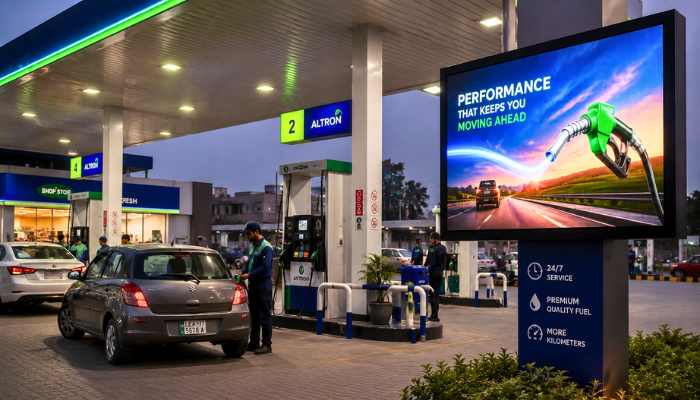
Every petrol pump in Lahore, Karachi, Islamabad, Rawalpindi, and Faisalabad sees hundreds of vehicles daily, and each customer spends several idle minutes waiting for fuel, checking tires, or grabbing something from the convenience store. Unlike a billboard glanced at while driving past, a led screen at a fuel station is seen up close, repeatedly, by the same regular customers — a stronger recall pattern than most outdoor media.
Despite this, most fuel stations in Pakistan still rely on static banners and printed price boards. LED screens are only beginning to appear at premium stations in major cities, which means early adopters stand out immediately against competitors on the same road.
Where to Install LED Screens at a Fuel Station
1. Canopy-Mounted Screens
Mounted on the underside or edge of the fuel canopy, facing the pumps. This is the highest-visibility spot since it’s directly in the driver’s line of sight while fuel is being pumped.
2. Forecourt Pole Displays
Free-standing double-sided LED poles near the entrance, visible to both incoming traffic and vehicles already on the forecourt. Useful for pricing, promotions, and brand ads.
3. Convenience Store / Indoor Screens
Smaller indoor SMD or LCD-style screens near the checkout counter, showing product promotions, snacks, or drinks — similar to retail digital signage but scaled to a small footprint.
4. Price Board Digital Displays
Digital fuel price boards replacing static painted boards, updated instantly when prices change nationally — removing the cost and delay of repainting.
Recommended Specifications by Placement
| Placement | Pixel Pitch | Brightness | IP Rating | Notes |
|---|---|---|---|---|
| Canopy-mounted | P4 – P6 | 5,000–7,000 nits | IP65 front | Must handle heat under canopy lighting |
| Forecourt pole | P5 – P8 | 6,000+ nits | IP65 both sides | Double-sided for two-way visibility |
| Convenience store | P2.5 – P3 | 800–1,200 nits | Indoor rated | Close-range viewing, finer pitch needed |
| Digital price board | P6 – P10 | 5,000+ nits | IP65 front | Large digits, low resolution is fine |
Why Outdoor-Grade Screens Are Non-Negotiable
Fuel stations sit exposed to direct sun, dust, and — during Pakistan’s monsoon months — heavy rain and humidity. A screen without at least IP65 front protection will degrade quickly from dust ingress alone, before humidity even becomes a factor. Heat is a second concern: canopy areas trap warm air, so screens here need better thermal management than a typical outdoor billboard application, or brightness and lifespan drop faster than expected.
The Revenue Angle: Screens That Pay for Themselves
A fuel station doesn’t have to absorb the full cost of an LED screen as a pure marketing expense. Once installed, ad space can be sold or bartered to:
- FMCG brands (soft drinks, snacks, motor oil) wanting exposure to a captive vehicle-owning audience
- Telecom companies running local promotions
- Nearby restaurants, workshops, and car service centers
- The fuel company itself, for national brand campaigns and safety messaging
This turns the screen from a cost center into a secondary revenue stream, especially for stations on high-traffic routes like the Lahore Ring Road, Karachi’s Shahrah-e-Faisal, or Islamabad Highway.
Content Strategy for Fuel Station Screens
- Keep loops short (10–15 seconds per ad) since attention spans at a fuel station are brief
- Mix fuel pricing/updates with paid ads so the screen still feels useful, not purely commercial
- Use high-contrast, simple graphics — screens are often viewed at an angle while a customer is inside their vehicle
- Update convenience-store screens more frequently than canopy screens, since indoor customers linger longer and notice repetition
Common Mistakes to Avoid
- Installing an indoor-rated panel outdoors to save cost — it fails within months against sun and dust
- Ignoring canopy heat buildup, which shortens LED lifespan faster than standard outdoor exposure
- Overcomplicating content with fast-moving video that’s hard to read from a moving or turning vehicle
- Skipping a site survey — canopy height, roof structure, and cable routing vary significantly between stations
FAQs
Q: What size LED screen is right for a fuel station canopy?
A: Most canopy installations range from 8×4 feet to 16×8 feet depending on canopy width and viewing distance from the pumps — a site survey determines the right size.
Q: Can digital price boards update automatically?
A: Yes, when connected to a content management system, price boards can update instantly across one or multiple stations without manual repainting.
Q: How much does an LED screen cost for a petrol pump?
A: Cost depends on size, pixel pitch, and brightness rating — canopy and forecourt installations require outdoor-grade components, which cost more than indoor convenience-store screens. A site-specific quote from Lahore, Karachi, or Islamabad-based suppliers is recommended.
Q: Do fuel station LED screens need special maintenance?
A: Yes — more frequent dust cleaning than typical outdoor installations due to constant vehicle exhaust and road dust exposure at ground level.
Q: Can fuel stations earn money from these screens?
A: Yes, by selling ad slots to FMCG brands, telecom companies, or local businesses, partially or fully offsetting the installation cost over time