
Why Pharmacies Are a Different Kind of LED Screen Buyer
Most LED screen buyers — restaurants, clothing stores, showrooms — want attention and impulse action. A pharmacy customer is usually there for a specific need, often stressed, unwell, or in a hurry. A screen that behaves like a retail ad wall can feel out of place or even reduce trust in a healthcare environment. This means pharmacy signage has a different job: inform clearly, reduce wait-time friction, and reinforce credibility — not just sell.
This makes content strategy, not just hardware, the deciding factor in whether an LED screen helps or hurts a pharmacy’s image.
Where LED Screens Add Value in a Pharmacy
1. Storefront Signboard
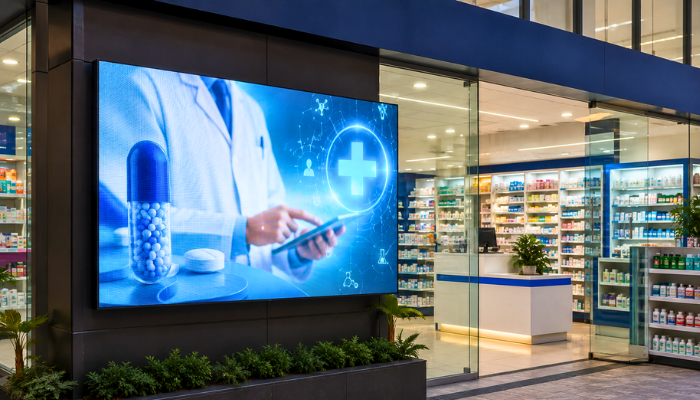
A well-lit outdoor LED board with the pharmacy name, “Open 24 Hours” status, and emergency contact number is often the single most useful screen for a pharmacy — visible from the street, especially valuable at night when customers are searching for an open pharmacy.
2. Medicine Availability & Queue Display
Indoor screens showing prescription queue numbers or general stock availability (e.g., “Insulin and diabetic supplies in stock”) reduce the need for customers to ask at the counter, especially useful during high-footfall hours.
3. Health Awareness Content
Rotating health tips, seasonal illness advisories (flu season, dengue prevention, heatstroke warnings common in Pakistani summers), and vaccination reminders position the pharmacy as a community health resource rather than just a retail point.
4. OTC Product & Wellness Promotions
Over-the-counter items — vitamins, skincare, baby care products — can be promoted on a smaller counter-facing screen, kept visually distinct from medical/prescription information so customers don’t confuse promotional content with medical guidance.
Recommended Specifications
| Placement | Pixel Pitch | Brightness | Notes |
|---|---|---|---|
| Outdoor storefront board | P6 – P10 | 5,000+ nits | Needs to be readable day and night |
| Indoor counter/queue display | P2.5 – P4 | 800–1,200 nits | Close viewing distance, needs fine pitch |
| Health awareness wall screen | P3 – P4 | 1,000–1,500 nits | Positioned where waiting customers naturally look |
Content Guidelines for Pharmacy Screens
- Separate medical information from promotional content — use distinct screens or clearly separated sections, not mixed loops
- Avoid flashing, fast-cut animations common in retail ads; pharmacy content should feel calm and easy to read at a glance
- Keep health advisories factual and simple — a screen is not the place for detailed medical claims
- Update seasonal content regularly (flu advisories in winter, heatstroke warnings in summer, dengue awareness during monsoon)
- If displaying medicine pricing, ensure it matches current in-store pricing exactly, the same way a printed price list would need to
Installation Considerations
- 24-hour pharmacies need screens rated for continuous operation without performance degradation over extended daily runtime
- Storefront boards should be positioned for visibility from both walking and vehicle traffic, especially in areas with night-time emergency pharmacy needs
- Indoor screens should avoid glare from overhead pharmacy lighting, which is typically brighter than retail store lighting
- Queue/token displays should sync properly with any existing token or queue management system already in use at the counter
Common Mistakes to Avoid
- Treating pharmacy signage exactly like retail advertising — tone and pacing should differ
- Overcrowding one screen with both promotional and medical information
- Choosing brightness too low for a storefront board meant to be read at night by someone searching for an open pharmacy
- Neglecting regular content updates, leaving outdated seasonal health advisories running for months
FAQs
Q: What’s the most useful LED screen for a small pharmacy?
A: A storefront signboard showing the pharmacy name, operating hours, and emergency contact is typically the highest-value single screen, especially for pharmacies open late or 24 hours.
Q: Can one screen show both health tips and product promotions?
A: It’s possible but not ideal — separating medical/informational content from promotional content, even with a simple visual divider, keeps the messaging clear and trustworthy.
Q: Do pharmacy LED screens need to be brighter than regular retail screens?
A: Storefront boards generally do, since they’re often read at night by customers searching for an open pharmacy. Indoor counter screens don’t need the same brightness level.
Q: Are there restrictions on what pharmacies can display on screens?
A: Displayed pricing and health information should be as accurate as printed signage would need to be — a screen doesn’t reduce the accuracy standard, it just changes the format.
Q: Can queue or token numbers be shown on an LED screen?
A: Yes, if synced with the pharmacy’s existing queue management system, reducing the need for customers to repeatedly ask about their turn.