| ⚡ TL;DR — Quick Answer
• Restaurant LED screens fall into four types — menu boards, drive-thru/storefront screens, food court directory walls, and in-store ambiance screens — each needing a different pixel pitch and brightness. • Menu boards run fine pixel pitch (P1.8–P2.5) since customers read them from close range at the counter. • Drive-thru and storefront screens need high-brightness, weatherproof panels to stay legible against daylight. • Pro SMD Screen supplies and installs restaurant-grade LED displays with Qiangli, Dahua, Unilumin, Absen, and LianTronics panels across Pakistan. |
Why Restaurants Are Replacing Printed Menus with LED Screens
Menu pricing in Pakistan’s food sector changes often enough that reprinting physical boards has become a recurring operational cost most restaurant owners would rather avoid. A digital menu board solves this instantly — prices, combos, and promotions update in minutes rather than requiring a new print run, and the same screen can highlight limited-time offers without needing extra signage.
Beyond cost savings, LED menu displays simply sell better. Bright, well-lit visuals of food draw more attention at the counter than static printed boards, and rotating promotional content gives cashiers a natural upsell prompt without having to say anything.
The Four Screen Types Used in Food Service
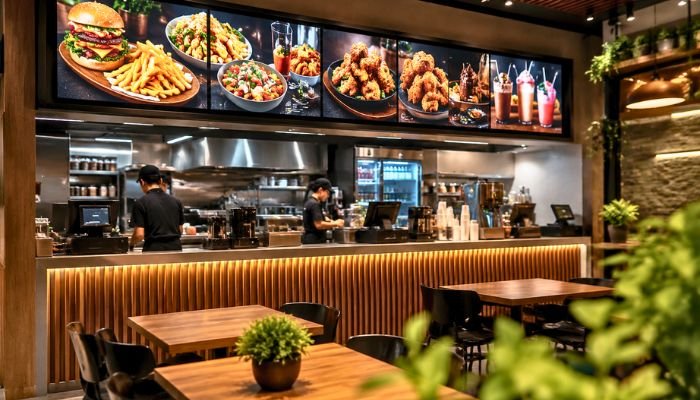
Menu Board Displays
Positioned directly above or behind the order counter, these need fine pixel pitch since customers stand close while deciding and ordering. Brightness needs to hold up against typical counter and kitchen lighting without washing out.
Drive-Thru & Storefront Screens
Facing outward toward a drive-thru lane or street-facing window, these compete with direct daylight and need considerably higher brightness along with weatherproof housing, similar in spec to outdoor advertising displays.
Food Court Directory Walls
Common in shopping mall food courts, a central directory screen can rotate menu highlights from multiple vendors, useful for mall operators managing shared food court space across several tenants.
In-Store Ambiance & Promotional Screens
Placed in the dining area rather than at the order point, these run subtler content — brand visuals, seasonal promotions, or simply ambiance loops that fit the restaurant’s interior design rather than looking like an advertisement.
Matching Pixel Pitch to Each Screen Type
| Screen Type | Typical Location | Pixel Pitch | Key Requirement |
| Menu Board Display | Above counter, order point | P1.8–P2.5 | Bright, close-viewing clarity, easy price updates |
| Drive-Thru / Storefront Screen | Outdoor-facing, drive-thru lane or window | P4–P6, high-brightness | Weatherproof, high nits to beat daylight glare |
| Food Court Directory Wall | Central atrium in mall food courts | P2.5–P4 | Large format, multi-vendor content rotation |
| In-Store Ambiance / Promo Screen | Dining area, waiting zone | P2.5–P3 | Subtle content, brand-matched visuals |
Getting brightness right matters more for restaurants than most indoor verticals — a menu board that looks perfect during a supplier demo can appear dim once installed under bright kitchen lighting or facing a sunlit storefront window.
Content Strategy for Restaurant Screens
- Full menu display with pricing that updates instantly across all locations from a central system
- Limited-time offers and combo promotions rotated throughout the day
- Time-based menu switching — breakfast, lunch, and dinner boards on the same screen
- Appetizing food photography and video loops to draw counter attention
- Order-ready and queue number displays for fast-casual and food court formats
Multi-location restaurant chains benefit most from centralized content management — updating pricing once and pushing it to every branch’s screen simultaneously, rather than coordinating printed menu changes location by location.
Installation Considerations for Food Service Environments
Kitchen and Counter Lighting
Menu boards need brightness calibrated against the specific lighting at the order counter, which varies significantly between a bright fast-food counter and a dim cafe interior.
Grease, Heat, and Cleaning
Screens near kitchens or open cooking areas need housing that tolerates heat and regular cleaning without damage, a consideration less relevant to office or retail installations.
Multi-Location Content Sync
Chains with multiple branches need a content-management setup that pushes menu and pricing updates to every location at once, avoiding the inconsistency of different branches showing different prices.
Drive-Thru Weatherproofing
Outdoor-facing drive-thru screens need full weatherproofing for Pakistan’s heat, dust, and monsoon conditions, along with anti-glare consideration for different times of day.
Cost Factors for Restaurant LED Screens
- Menu board screens are relatively low-cost given their smaller size, often the fastest-payback digital signage investment for any restaurant
- Drive-thru and storefront screens cost more due to brightness and weatherproofing requirements
- Multi-location chains benefit from centralized content-management software, which adds a modest ongoing cost but eliminates per-branch printing expenses entirely
- Food court directory walls are typically funded by the mall operator and offered to vendors as a shared amenity
Why Restaurants and Food Court Operators Choose Pro SMD Screen
Pro SMD Screen, based in Lahore, supplies and installs indoor and outdoor LED display solutions for restaurants, cafes, and food court operators across Pakistan. As an authorized dealer for Qiangli, Dahua, Hikvision, Unilumin, Absen, and LianTronics, the company matches panel brightness and pixel pitch to each restaurant’s specific counter and storefront conditions.
Restaurant engagements typically include a site assessment of counter and storefront lighting, brightness and pixel-pitch recommendations, and content-management setup that supports single-location or multi-branch pricing updates.
Frequently Asked Questions
Q: What pixel pitch is best for a restaurant menu board?
A: P1.8 to P2.5 is typical, since customers view menu boards from close range while ordering at the counter.
Q: Can menu prices be updated instantly across multiple branches?
A: Yes, with a centralized content-management setup, pricing and menu changes can be pushed to every branch’s screen simultaneously instead of updating each location separately.
Q: Do drive-thru screens need special weatherproofing in Pakistan?
A: Yes, drive-thru and storefront-facing screens need full outdoor weatherproofing along with high brightness to remain legible against daylight and Pakistan’s climate conditions.
Q: Can one screen show breakfast, lunch, and dinner menus automatically?
A: Yes, content can be scheduled to switch automatically at set times, so the same screen displays the appropriate menu without manual intervention.
Q: Are food court directory screens shared across multiple vendors?
A: Typically yes — mall operators often fund a central directory wall and rotate content from multiple food court tenants on the same screen.
Q: Does Pro SMD Screen serve restaurants outside Lahore?
A: Yes, Pro SMD Screen serves restaurants, cafes, and food court operators across Pakistan, including Karachi, Islamabad, and Rawalpindi, with a site assessment arranged before every quote.
Get a Restaurant LED Screen Quote
Pro SMD Screen works with restaurants, cafes, and food court operators across Pakistan to design LED menu boards, drive-thru screens, and dining area displays. Contact the team on +92-42-3592-9400 or +92-321-4086763 for a site assessment and quote-based proposal.