What Makes a Curved LED Screen Different
A curved LED screen isn’t a bent version of a normal panel — it uses flexible PCB (printed circuit board) modules specifically manufactured to bend along one axis, usually convex or concave, without breaking the LED connections. Standard SMD screen panels are rigid and will crack or delaminate if forced into a curve, so curved installations always require purpose-built flexible modules from the start.
This makes curved screens a design decision, not a retrofit option. A business has to decide on a curved screen before ordering, not switch a flat panel to curved later.
Where Curved Screens Make Sense
1. Brand Flagship Stores
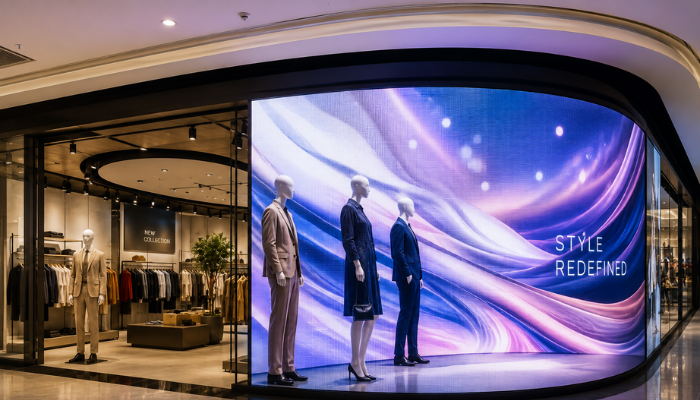
Fashion and electronics brands use curved LED as a signature architectural feature — wrapping around a store entrance pillar or forming an arched display above the doorway, turning the screen itself into part of the store’s identity rather than just signage.
2. Mall Centerpieces
Shopping malls in Lahore and Karachi are starting to install cylindrical or dome-shaped LED installations in atriums, visible from multiple floors, creating a landmark visual rather than a flat ad panel.
3. Hotel Lobbies & Reception Areas
Curved screens behind reception desks or wrapping a lobby column give a premium, custom-built impression that flat screens don’t achieve.
4. Corporate Showrooms
Car and real estate showrooms use gently curved screens to match rounded architectural elements already in the building design, rather than forcing a flat screen into a round space.
Curve Types Explained
| Curve Type | Description | Common Use |
|---|---|---|
| Convex (outward bend) | Screen bulges toward viewer | Pillar wraps, columns |
| Concave (inward bend) | Screen curves away from viewer | Cove ceilings, immersive walls |
| Cylindrical | Full or partial wrap, constant radius | Mall centerpieces, lobby features |
| S-curve / wave | Alternating bends | High-end architectural feature walls |
Key Technical Considerations
| Factor | What to Check | Why It Matters |
|---|---|---|
| Minimum bend radius | Manufacturer-rated limit per module | Forcing a tighter curve than rated damages LEDs |
| Pixel pitch | P2.5 – P6 typical for curved indoor | Finer pitch needed at close viewing distance |
| Mounting frame | Custom-fabricated to match curve | Off-the-shelf brackets don’t fit curved surfaces |
| Seam visibility | Module gap consistency along the curve | Curves can widen gaps between panels if not calibrated |
| Content mapping | Video content pre-adjusted for curve | Straight footage looks distorted on a curved surface without mapping |
Cost Factors
Curved LED screens cost more than an equivalent flat panel because of three added factors: the flexible PCB technology itself, a custom-fabricated mounting frame built to the exact curve radius, and more complex installation labor. Buyers in Lahore, Karachi, or Islamabad should expect a site visit and custom design phase before receiving a firm quote — curved installations are rarely a standard catalog item.
Content Design for Curved Screens
Flat video content played on a curved screen without adjustment will visibly stretch or compress at the edges. Proper curved-screen content either:
- Uses processing software that maps flat video onto the curved surface geometry, or
- Is originally designed and rendered accounting for the curve (common for branded architectural installations)
Simple animations, logos, and color gradients tend to work better on curved screens than detailed video with straight lines, since straight lines are what visibly distort on a curve.
Installation Considerations
- Structural assessment for the custom frame’s weight distribution across the curve
- Cable routing planned around the curve shape, often more complex than a flat wall-mount
- Calibration pass after installation to correct any brightness or color variance across bent modules
- Access planning for future servicing, since curved installations are harder to access than flat wall-mounted panels
Common Mistakes to Avoid
- Ordering flat panels and expecting installers to bend them on-site — this damages the modules
- Skipping content mapping and using straight promotional video as-is
- Underestimating installation timeline — curved installs take longer than flat wall mounts due to custom framing
- Choosing curve radius based on aesthetics alone without confirming it’s within the panel’s rated bend limit
FAQs
Q: Can any SMD screen be curved during installation?
A: No. Only flexible PCB modules manufactured for curving can bend safely — standard rigid panels will crack if forced into a curve.
Q: What’s the minimum curve radius possible?
A: It depends on the specific flexible module’s manufacturer rating, typically ranging from under 1 meter to several meters — always confirm the rated limit before finalizing design.
Q: Do curved screens cost significantly more than flat ones?
A: Yes, generally higher due to flexible PCB technology, custom mounting frames, and more complex installation labor.
Q: Is special content needed for curved screens?
A: Ideally yes — content mapped or designed for the curve avoids visible distortion, especially with straight lines or detailed video.
Q: Where are curved LED screens most commonly used in Pakistan?
A: Currently most common in flagship retail stores, premium hotel lobbies, and mall atrium installations in major cities like Lahore, Karachi, and Islamabad.