Why Cabinet Type Matters More Than Buyers Expect
Most first-time SMD screen buyers focus on pixel pitch and brightness, and treat the cabinet — the physical frame holding the LED modules — as an afterthought. This is backwards. Cabinet type determines how the screen is transported, assembled, mounted, and maintained, and choosing the wrong type creates problems that pixel pitch or brightness specs can’t fix. A rental-grade screen bought for a permanent wall installation will cost more than necessary and offer no long-term benefit. A fixed-installation screen bought for frequent event use will be heavy, slow to assemble, and prone to damage during repeated transport.
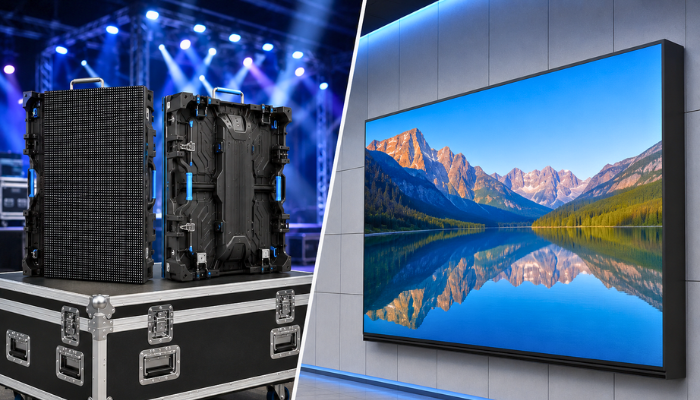
Rental Cabinets: Built for Movement
Key characteristics:
- Die-cast aluminum construction, lightweight for repeated loading/unloading
- Quick-lock or toolless locking systems for fast on-site assembly and disassembly
- Standard sizes (commonly 500mm x 500mm or 500mm x 1000mm) that stack into flight cases for transport
- Front and rear service access, since rental screens are assembled and struck down under time pressure at event venues
- Curved-capable variants available for stage backdrops and arched displays
Best suited for:
Wedding halls and banquet event staging, concerts and outdoor jalsas, exhibition and trade show booths, and any application where the screen is assembled, used for a limited period, then disassembled and moved to the next location.
Fixed Installation Cabinets: Built for Permanence
Key characteristics:
- Steel or aluminum frame, generally heavier and sturdier than rental cabinets
- Simpler mounting hardware — wall brackets, hanging structures, or floor stands designed for one-time installation
- Not optimized for repeated disassembly; removing and reinstalling a fixed cabinet is a maintenance event, not a routine occurrence
- Rear-access maintenance panels, since front access isn’t needed for a screen that stays mounted long-term
- Generally lower per-unit cost than equivalent rental cabinets, since the lightweight/portability engineering isn’t needed
Best suited for:
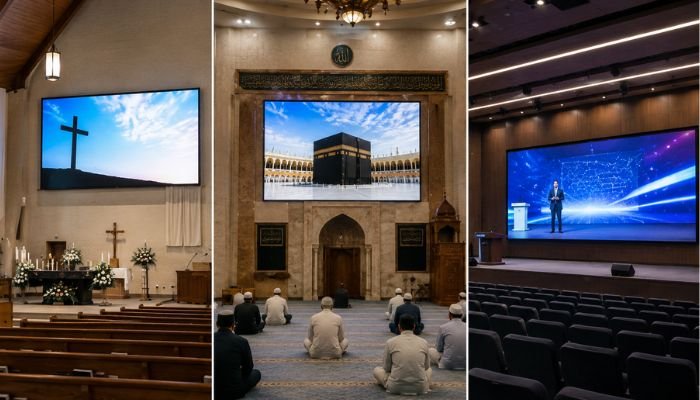
Retail storefronts, control rooms, restaurant menu boards, showroom walls, mosque displays, and any application where the screen is installed once and remains in place for years.
Rental vs Fixed: Direct Comparison
| Factor | Rental Cabinet | Fixed Installation Cabinet |
|---|---|---|
| Material | Die-cast aluminum | Steel or aluminum |
| Weight | Lighter, transport-optimized | Heavier, stability-optimized |
| Assembly | Toolless, quick-lock, fast | One-time, standard mounting hardware |
| Access for service | Front and rear | Typically rear only |
| Typical use | Events, weddings, concerts, exhibitions | Retail, showrooms, control rooms, permanent signage |
| Cost per unit | Higher | Lower |
| Transport durability | Built for repeated moves | Not designed for repeated moves |
How to Decide Which Cabinet Type You Need
Ask one question first: will this screen be assembled and disassembled repeatedly, or installed once and left in place? If the answer involves events, rentals, or any scenario where the screen travels between locations, rental cabinets are the correct choice regardless of budget pressure — fixed cabinets won’t survive repeated transport without damage. If the screen goes up once in a showroom, storefront, or control room and stays there, a fixed cabinet is both more cost-effective and more durable for that stationary use.
Businesses that need both — for example, an event company that also wants a small showroom display — should treat these as two separate purchase decisions rather than trying to use one cabinet type for both purposes.
Common Mistakes to Avoid
- Buying rental cabinets for a permanent installation, paying for portability features that add no value in a fixed setup
- Buying fixed cabinets for event use, then damaging them through repeated disassembly they weren’t designed for
- Not confirming flight-case compatibility before committing to a rental cabinet size, leading to transport logistics problems later
- Assuming cabinet type is a minor detail decided after pixel pitch — it should be the first decision, since it affects mounting, transport, and total cost
FAQs
Q: Can a rental cabinet be used for a permanent installation?
A: Yes, technically, but it’s not cost-efficient — buyers pay for portability engineering (quick-lock systems, lightweight frames) that provides no benefit once the screen is permanently mounted.
Q: Can a fixed cabinet be used for occasional event rentals?
A: It’s possible for very infrequent use, but repeated assembly and disassembly will cause wear and damage faster than a cabinet designed for that purpose.
Q: Which cabinet type is more affordable?
A: Fixed installation cabinets are generally lower cost per unit, since they don’t require the lightweight, quick-assembly engineering built into rental cabinets.
Q: What size are standard rental cabinets?
A: Common sizes are 500mm x 500mm and 500mm x 1000mm, designed to stack efficiently into flight cases for transport between venues.
Q: Does cabinet type affect pixel pitch options?
A: Not directly — both rental and fixed cabinets are available across various pixel pitches. Cabinet type affects mounting and transport, not resolution.