
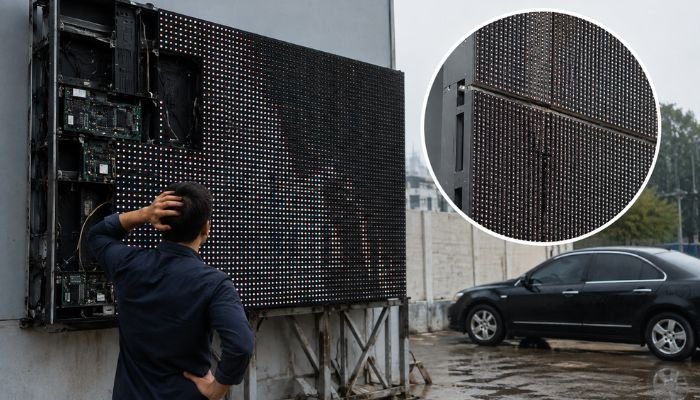
| TL;DR — Quick Answer
Cheap SMD screens fail early because buyers focus only on price and skip the details that determine lifespan: chip quality, IP rating, driver ICs, power supply grade, and installation standards. The 10 most common mistakes are buying on price alone, ignoring IP ratings, choosing the wrong pixel pitch, skipping brightness (nits) checks, using unbranded chips, poor power supply units, weak structural mounting, no maintenance plan, ignoring warranty terms, and skipping a proper site survey. A reliable supplier like Pro SMD Screen helps buyers avoid every one of these mistakes with correctly specified, climate-rated panels built for Pakistan’s outdoor conditions. |
Introduction
Every week, somewhere in Lahore, Karachi, or Islamabad, a shopkeeper or event organizer signs off on the lowest quote for an SMD screens — and every week, somewhere else in the same cities, that same type of screen is being pulled down early: dead pixels spreading across the panel, colors shifting green or purple, a power supply that’s already been replaced twice, or a structure that failed to survive a single dust storm.
This isn’t bad luck. It’s the predictable result of ten specific mistakes that keep repeating across the Pakistani SMD screens market. The good news is that every one of them is avoidable — if you know what to check before you sign the invoice, not after the panel starts failing.
This guide walks through exactly what separates a screen that lasts 8–10 years from one that limps to 12 months, so you can buy with confidence instead of regret.
The 10 Mistakes at a Glance
Mistake #1: Buying on Price Alone
The single biggest reason cheap SMD screens fail is that the buying decision starts and ends with the quoted price. Two screens that look identical on a spec sheet can have completely different chip grades, driver ICs, and build quality — and the difference only shows up six months later, when one is still running smoothly and the other has visible dead spots.
The fix is simple: ask what’s actually behind the price. A supplier who can explain the chip brand, the panel’s expected lifespan, and the warranty terms in specific detail is giving you real information. A supplier who only talks about size and price per square foot usually isn’t.
Mistake #2: Ignoring the IP Rating
IP (Ingress Protection) ratings describe how well a panel resists dust and water. For outdoor SMD screens in Pakistan — where monsoon rain, humidity, and dust storms are a yearly reality — anything below IP65 is a risk. Cheap outdoor panels are frequently sold with indoor-grade or lightly sealed housings, which look fine on a dry showroom floor and fail within the first monsoon season.
Always confirm the IP rating in writing, and match it to where the screen will actually be installed: IP65 or higher for outdoor, IP30–IP40 is generally acceptable for fully indoor, climate-controlled spaces.
Mistake #3: Choosing the Wrong Pixel Pitch
Pixel pitch — the distance between LED clusters, expressed as P2, P3, P4, P6, P10, and so on — determines how sharp the image looks at a given viewing distance. Buying a tight pixel pitch like P2 for a billboard viewed from 50 feet away wastes money on resolution nobody will notice. Buying a wide pitch like P10 for an indoor reception screen viewed up close results in a grainy, unprofessional image.
The right pixel pitch is a function of viewing distance, not just budget — and getting it wrong either overspends or undersells your brand image.
Mistake #4: Skipping the Brightness (Nits) Check
Brightness is measured in nits, and it’s one of the most overlooked specs in budget SMD screens deals. An outdoor screen facing direct Lahore or Karachi sunlight needs roughly 5,000 nits or higher to stay legible at midday — anything lower washes out completely, turning an expensive display into an invisible one for several hours a day.
Cheap panels often quote a brightness figure that’s technically true only in a dim test room, not under real outdoor sun. Always ask for the sustained outdoor brightness rating, not a lab-only number.
Mistake #5: Unbranded or Uncertified LED Chips
The LED chip is the heart of any SMD screens, and it’s also the easiest place for a cheap supplier to cut corners invisibly. Unbranded chips from unverified sources often have inconsistent color calibration across the panel, shorter operational life, and a much higher rate of early pixel failure.
Reputable suppliers source from established manufacturers with a track record — names like Qiangli, Dahua, Hikvision, Unilumin, Absen, and LianTronics — precisely because chip consistency is what determines whether a screen still looks uniform in year three.
Mistake #6: Low-Grade Power Supply Units
An SMD screens is only as reliable as the power supply feeding it. Budget screens frequently pair good-looking panels with the cheapest available power supply units, which leads to flickering, uneven brightness across the panel, and — in the worst cases — a genuine fire risk from overheating components.
A quality power supply is not a place to save money. It’s the component working hardest, every hour the screen is on.
Mistake #7: Weak Structural Mounting
A screen can have excellent panels and still fail because of what it’s mounted on. Cheap installations often skip proper structural engineering — using undersized frames, inadequate anchoring, or ignoring wind-load calculations for the location. In a country where dust storms and high winds are seasonal, this isn’t a cosmetic shortcut; it’s a safety issue for anyone standing near the display.
A proper installation accounts for the screen’s weight, the mounting surface, and the wind exposure of the specific site — not a generic bracket used everywhere regardless of conditions.
Mistake #8: No Maintenance Plan
Even a well-built SMD screens needs periodic checks: cleaning dust from vents, checking connector integrity, verifying the power supply is running within normal parameters. Buyers who skip a maintenance plan entirely often don’t notice a small, cheap-to-fix fault until it’s cascaded into a full module failure.
A basic quarterly check can extend a screen’s working life by years and catch problems while they’re still a minor repair instead of a replacement.
Mistake #9: Vague or Non-Existent Warranty Terms
Cheap SMD screens are frequently sold with warranty language that sounds reassuring but says very little — no clear timeframe, no specifics on what’s covered, and no defined process for claims. When a panel does fail, buyers discover the warranty offers little real protection.
Before buying, get warranty terms in writing: duration, what components are covered, and how a claim is actually processed. A supplier confident in their build quality will have no problem putting this on paper.
Mistake #10: Skipping a Proper Site Survey
The final and most overlooked mistake is buying a screen without anyone actually assessing the installation site — viewing distance, ambient light conditions, available power supply, mounting surface, and structural considerations. A screen that would be perfect for one location can be entirely wrong for another, and no amount of panel quality fixes a mismatch between the screen and its environment.
A proper site survey — the kind Pro SMD Screen conducts before recommending any panel — is what turns a generic product into a display that’s actually right for your business.
How to Avoid All 10 Mistakes: A Buyer’s Checklist
Ask for the chip brand by name, not just “imported” or “branded.”
Get the IP rating in writing, matched to indoor or outdoor use.
Confirm pixel pitch based on real viewing distance, not just what’s cheapest.
Request sustained outdoor brightness in nits, not a lab-only figure.
Ask what power supply brand is used and its rated lifespan.
Insist on a structural assessment for outdoor installations.
Get a written maintenance schedule included with the purchase.
Read the warranty terms fully before signing anything.
Request a site survey before finalizing screen size or pixel pitch.
Compare total cost over 5 years, not just the upfront quote.
Why Working With an Established Supplier Matters
None of these ten mistakes require special expertise to avoid — they require a supplier willing to answer specific technical questions honestly, rather than steering every conversation back to price. This is the real difference between a screen that becomes a long-term asset and one that becomes a recurring headache.
Pro SMD Screen works directly with established panel manufacturers — including Qiangli, Dahua, Hikvision, Unilumin, Absen, and LianTronics — and builds every quote around a real site assessment, not a generic price-per-square-foot number. That’s the difference buyers feel two years later, when their screen is still running exactly as it did on day one.
Frequently Asked Questions
Q1: How can I tell if an SMD screens is cheaply made before buying it?
Ask for the chip brand, IP rating, sustained outdoor brightness, and warranty terms in writing. Vague or evasive answers to any of these are a strong warning sign.
Q2: Is a higher price always a guarantee of quality?
Not automatically, but a supplier charging more can usually justify it with specific technical details — chip brand, IP rating, structural engineering — rather than just a bigger number on the invoice.
Q3: How long should a properly built SMD screens last in Pakistan?
A correctly specified panel with quality chips, an IP65 rating for outdoor use, and regular maintenance typically performs reliably for 8–10 years.
Q4: What’s the most common failure point on cheap SMD screens?
Power supply units and unbranded LED chips are the two most frequent failure points, followed closely by inadequate IP ratings on outdoor installations.
Q5: Do I need a site survey even for a small indoor screens?
Yes. Even small indoor screens need the right pixel pitch and brightness for their viewing distance and ambient lighting — skipping this step is a common reason indoor displays look worse than expected.
Final Word
A cheap SMD screens rarely stays cheap. Between early replacement, wasted electricity on inefficient units, repair callouts, and the lost advertising impact of a screen that’s dim, flickering, or partially dead, the true cost of cutting corners usually exceeds what a properly specified screen would have cost from the start.
The ten mistakes covered here aren’t rare edge cases — they’re the default outcome of choosing on price alone. Avoid them by asking the right questions, insisting on documentation, and working with a supplier who treats a site survey as a standard step, not an optional extra.
| Don’t Let a Cheap Screen Cost You Twice
Talk to Pro SMD Screen before you buy. Get a free technical consultation and a correctly specified SMD screens built for your budget and your location. 📍 658 B Block, Faisal Town, Lahore | 📞 +92-42-3592-9400 / +92-321-4086763 Visit prosmdscreen.com to request your free quote |