
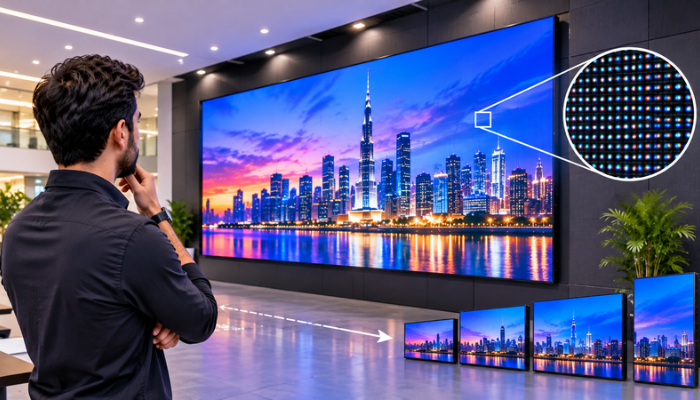
Quick Answer: Calculating SMD screen resolution in Pakistan requires multiplying physical cabinet pixel matrices by total display dimensions to achieve native Full HD (1080p), 2K, or 4K resolutions based on optimal audience viewing distance (e.g., P1.53 for 1.5m vs P4 for 4m+). Pro SMD Screen engineers precision fine-pitch and outdoor video walls with Unilumin, Hikvision, LAMPRO, and Absen hardware across Lahore, Karachi, and Islamabad.
Unlike a television, an LED video wall has no fixed resolution. Its sharpness depends on how many pixels fit into the physical size you build, which is why buyers who ask for “4K” without giving dimensions receive confusing quotations. Understanding smd screen resolution lets you check any proposal yourself. This guide shows the formulas, a ready pixel matrix and the viewing distances that Pro SMD Screen uses when engineering commercial walls.
How SMD Screen Resolution Is Calculated
Resolution is the screen dimension divided by the pixel pitch. Pixel pitch is the distance in millimetres between the centres of two neighbouring pixels, so a P2.5 panel has one pixel every 2.5 mm.
- Horizontal pixels= screen width (mm) ÷ pixel pitch (mm).
- Vertical pixels= screen height (mm) ÷ pixel pitch (mm).
- Screen size for a target resolution= pixels × pixel pitch. A 1920 × 1080 wall at P2.5 measures 4,800 × 2,700 mm.
The same formula works backwards for budgeting. If a lobby wall can only be three metres wide, a finer pitch is the only way to fit more pixels into it. Smaller pitch means higher resolution on the same area, and it also means more diodes and a higher project cost.
Total pixel count also drives the control system. Each sending card or video processor can drive only a limited number of pixels, so very large or very fine walls need several cards working together. Our engineers calculate this load early, because it affects the controller budget as much as the panels.
SMD Screen Resolution & Pixel Matrix Calculator
| Pixel Pitch | Cabinet 640 × 480 mm (pixels) | Cabinet 500 × 500 mm (pixels) | Module 320 × 160 mm (pixels) | Min. Viewing Distance | Native 16:9 1080p Screen Size |
| P1.25 | 512 × 384 | 400 × 400 | 256 × 128 | 1.25 m | 2,400 × 1,350 mm |
| P1.53 | 418 × 314 | 327 × 327 | 209 × 105 | 1.5 m | 2,938 × 1,652 mm |
| P1.86 | 344 × 258 | 269 × 269 | 172 × 86 | 1.9 m | 3,571 × 2,009 mm |
| P2.5 | 256 × 192 | 200 × 200 | 128 × 64 | 2.5 m | 4,800 × 2,700 mm |
| P3 | 213 × 160 | 167 × 167 | 107 × 53 | 3 m | 5,760 × 3,240 mm |
| P4 | 160 × 120 | 125 × 125 | 80 × 40 | 4 m | 7,680 × 4,320 mm |
Values use nominal pitch and are rounded. Some products use a slightly different effective pitch (P1.53 and P3 are common examples), so Pro SMD Screen confirms exact pixel counts against the datasheet of the selected model before production.
Cabinet Size: 640 × 480 mm Versus 500 × 500 mm
Two cabinet formats dominate commercial projects. The 640 × 480 mm cabinet has a 4:3 shape and is the standard for fixed indoor walls. The 500 × 500 mm cabinet is square, lighter, and popular in rental and creative installations because it builds curves and many different shapes easily.
The format affects the aspect ratio you can reach. A grid of four 640 × 480 cabinets across and three down measures 2,560 × 1,440 mm, which is an exact 16:9 shape. Square 500 mm cabinets need a 16 × 9 grid to reach the same ratio, so smaller walls in this format use custom cut-offs or accept a slightly different shape. Planning the grid before you order avoids wasted cabinets.
Choosing Pixel Pitch by Viewing Distance
A practical rule is that the minimum comfortable viewing distance in metres is roughly equal to the pixel pitch in millimetres. A P1.53 panel works from about 1.5 m, while a P4 panel is for audiences four metres or further away. Sitting closer reveals the individual pixel dots and makes text look rough.
- 25 to P1.86:control rooms, boardrooms, studios and reception walls viewed from one to two metres.
- 5 to P3:retail, banks, hospitals, showrooms and event halls viewed from two to five metres.
- P4:large halls, auditoriums and covered outdoor-facing areas where the audience sits further back.
Ideal viewing distance is usually two to three times the minimum, where the picture looks smooth and the whole screen sits comfortably in view. Choosing a finer pitch than necessary raises cost without a visible benefit, and choosing a coarser one saves money but weakens the image.
Content shapes the choice as well. A wall that mostly shows small text, such as queue numbers or price lists, needs a finer pitch than one that plays bold advertising video. As a guide, make sure the smallest important text is at least several pixels tall, otherwise it looks broken from the real audience position.
Reaching Full HD, 2K and 4K on LED Walls
Full HD is 1920 × 1080 pixels, 2K is about 2048 × 1080 and 4K UHD is 3840 × 2160. The cabinet grid rarely lands on these numbers exactly, so installers choose the nearest 16:9 grid and let the controller scale the source. For example, eight 640 × 480 cabinets across and six down at P2.5 measures 5,120 × 2,880 mm and gives 2,048 × 1,152 pixels, slightly above Full HD in the same 16:9 shape.
Native 4K needs far more area at coarse pitches. At P1.25 a 3840 × 2160 wall measures 4.8 × 2.7 m, while at P2.5 it grows to 9.6 × 5.4 m. This is why true 4K fine-pitch walls appear in control rooms and studios, and outdoor screens at P6 or coarser are judged by viewing distance rather than pixel count.
Whatever the target, keep the source content matched to the wall. Feeding a low-resolution video to a large high-density screen wastes the hardware, so design artwork at the native pixel size our engineers provide.
Aspect Ratio: 16:9, 4:3 and Custom Shapes
Most commercial content is produced in 16:9, so many walls follow that shape. Custom ratios are equally common in Pakistan: wide ribbon screens for building facades, tall portrait totems for malls, and ultra-wide ceiling feature walls in showrooms. LED technology allows any shape built from whole cabinets.
When the wall differs from the content ratio, the controller crops, stretches or adds borders. Our team sets these rules in the Novastar or Colorlight software during commissioning so the picture never looks distorted. We recommend sharing the content format with us at the quotation stage.
Common Resolution Mistakes Buyers Make
- Asking for 4K without dimensions:the label means nothing until size and pitch are stated.
- Choosing pitch by price alone:a coarse pitch at close range looks cheap however good the brand.
- Ignoring cabinet grid:the wall must be built from whole cabinets, so the final size moves in fixed steps.
- Using low-quality source files:blurry artwork stays blurry on any wall.
Brand Hardware Behind the Numbers
Resolution is only part of the picture. Pro SMD Screen supplies Unilumin, Hikvision, LAMPRO and Absen products, selecting each series for the pitch and environment. Fine pitches P1.25 to P1.86 suit indoor premium hardware with a 3,840Hz refresh rate, while P4 and P6 outdoor cabinets prioritize brightness, sealing and heat management. Explore our indoor SMD screens and outdoor LED screens to see the range.
Engineering Support Across Pakistan’s Commercial Centers
Our engineers survey the site, measure viewing distance, calculate the pixel grid and prepare the content specification before fabrication begins. Delivery and installation cover Lahore, Karachi and Islamabad, with reach into Rawalpindi and Faisalabad. Completed commercial work includes The Compound Gym Lahore in Faisal Town and video walls across Gulberg and Blue Area Islamabad.
Because the right resolution depends on dimensions, distance and content, we quote each project individually and publish no static prices.
Frequently Asked Questions
How do I calculate SMD screen resolution?
Divide the screen width and height in millimetres by the pixel pitch. A 4,800 × 2,700 mm wall at P2.5 gives 1920 × 1080 pixels.
Which pixel pitch should I choose for a given viewing distance?
As a rule of thumb, the minimum viewing distance in metres equals the pixel pitch in millimetres, so P1.53 suits about 1.5 m and P4 suits four metres or more.
What is the difference between 640 × 480 mm and 500 × 500 mm cabinets?
The 640 × 480 mm cabinet is a 4:3 format common in fixed indoor walls, while the 500 × 500 mm square cabinet is lighter and favoured for rental and shaped installations.
Can an LED wall be exactly Full HD or 4K?
It can be close, but cabinet grids rarely match the numbers exactly, so installers choose the nearest 16:9 grid and scale the source with the controller.
Conclusion
Getting resolution right means working from dimensions, pitch and viewing distance instead of marketing labels. Use the matrix above to test any